The Jubilee Centre Framework for Character Education in Schools

The Jubilee Centre Framework for Character Education in Schools sets out the Centre’s position on character education, what it is, and why it is important. The Framework calls for all schools to make explicit how they go about developing pupils’ character. The Framework was first published in 2013, then revised in 2017, with the latest iteration being published in 2022.

The current version includes the Jubilee Centre ‘Building Blocks of Character’, which breaks virtues down into four ‘types’, namely intellectual virtues, moral virtues, civic virtues, and performance virtues, working in combination towards the development of the meta-virtue of phronesis. 

The Building Blocks of Character

Intellectual virtues

Character traits necessary for discernment, right action and the pursuit of knowledge, truth and understanding.

Examples:
autonomy; critical thinking; curiosity; judgement; reasoning; reflection; resourcefulness.


Moral

virtues

Character traits that enable us to act well in situations that require an ethical response.


Examples:
compassion; courage; gratitude; honesty; humility; integrity; justice; respect.


Civic

virtues

Character traits that are necessary for engaged responsible citizenship, contributing to the common good.

Examples:
citizenship; civility; community awareness; neighbourliness; service; volunteering.


Performance virtues

Character traits that have an instrumental value in enabling the intellectual moral and civic virtues.


Examples:
confidence; determination; motivation; perseverance; resilience; leadership; teamwork.

Practical wisdom (phronesis) is the integrative virtue, developed through
experience and critical reflection, which enables us to perceive, know, desire, and
act with good sense. This includes discerning, deliberative action in situations
where virtues collide.

Flourishing individuals and society

Offering examples of best practice that may support the development of such virtues the integrated Character Teaching Inventory presents a comprehensive overview of 70 character education teaching strategies, from across character ‘caught’, ‘taught’, and ‘sought’, for schools to consider as part of their character education provision. The Inventory aim’s to illustrate how the Framework can be put into practice and, importantly, how character education can become an intentional, meaningful, and reflective part of whole school practice.

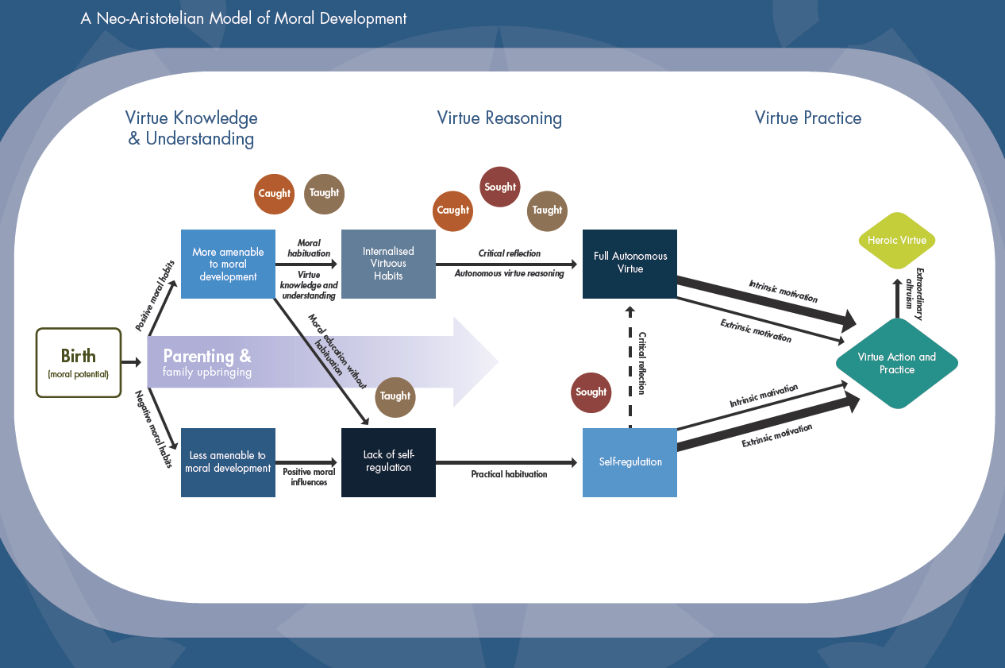
The Framework also includes ‘A Neo-Aristotelian Model of Moral Development’, which depicts possible pathways to ‘becoming virtuous’, through the Aristotelian lens of habituation, foregrounding the importance of early family upbringing. The 2022 third edition includes a rational and background to this model offering greater context and explanation of its intended application

A Neo-Aristotelian Model of Moral Development

The Framework is used to underpin the approach to all research that the Centre engages in and has, so far, been sent to over 10,000 schools across the UK, plus many others internationally. The Framework is intended to offer a perspective on character education for schools to consider, and not be treated as a blueprint for teaching character in schools. Whilst written in the language of schools, for teachers, the Framework is flexible and relevant to all individuals, organisations, and institutions seeking to articulate their approach to character development.

The Framework in Action project was led by The Jubilee Centre for Character and Virtues in partnership with five schools located across England, each with an exemplary character education provision.

The purpose of the project was to demonstrate how the Framework has been used as a source of inspiration by schools across the UK. The materials produced are wide-ranging, reflecting that there is no blueprint for teaching character, and include: lesson plans, curriculum resources, digital booklets, a character passport app and a character-focussed initial teacher training programme.