
Maureen Spelman
North Central College
The aim of this project was to evaluate the hypotheses that leadership candidates would advance in their development of virtue literacy and moral reasoning over a period of two years.

Project Overview
Virtue literacy has been defined as perceiving, knowing, and understanding virtue language and concepts needed to make reasoned judgements. While cultivating each of these components can lead to mastery of a particular virtue, the foundation must first be laid through the development of a common virtue vocabulary and opportunities to translate that knowledge into action.
The first aim of this grant supported research was to determine if candidates participating in character & virtue-based interventions would demonstrate advancements in the development of virtue literacy in the initial course and maintain or continue to demonstrate growth at the end of a two-year program. Writing samples gathered prior to the start of the educational leadership program, at the conclusion of the first course, and at the end of program provided data on the development of virtue literacy in aspiring leaders.
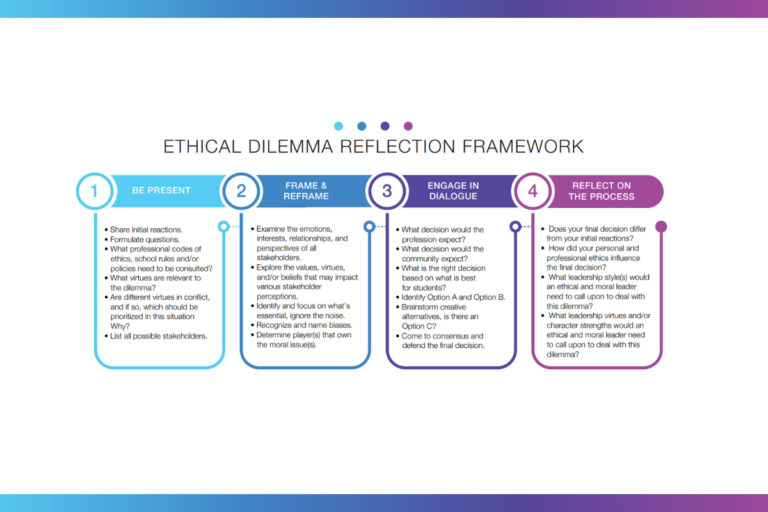
When virtues are viewed through a Neo-Aristotelian lens, they are interconnected and orchestrated by the meta-virtue of practical wisdom. A valuable method for developing moral decision-making processes and practical wisdom may be through sustained practice with authentic ethical dilemmas. Practicing with and responding to authentic ethical dilemmas through a structured reflective framework allows candidates to engage in collective phronesis, make sense of complexity, and choose an intelligent and virtuous response to ethical dilemmas.
The second aim of this research proposal was to determine if candidates exploring education-based dilemmas using an Ethical Dilemma Reflection Framework would demonstrate advancements in the development of moral reasoning in the initial course and maintain or continue to continue to demonstrate growth at the end of a two-year program. The Defining Issues Test administered prior to the start of the educational leadership program, at the conclusion of the first course, and at the conclusion of the capstone course provided data on the development of moral reasoning in aspiring leaders.
Two pending publications feature my unique Ethical Dilemma Reflection Framework that was first introduced in a 2023 Jubilee Centre report Teaching Character: A Practical Guide.
Pending publications
Book Chapter – Integrating Virtue Development into Educational Leadership Programs – accepted & in final editing – Teaching Educational Leadership, Edgar Elgar Publishing, publication confirmed – February 2026.
Manuscript – Cultivating Practically Wise Decision-Making: An Empirical Study on Leadership Formation – currently under review for a special issue of the Journal of Character Education.
Conference presentations
- Association of Moral Education – October 24-26, 2024 (New York)
- Wake Forest – Leadership & Character Conference – December 5-7, 2024 (Winston Salem, NC)
- 13th Annual Conference – Jubilee Center for Character & Virtue – January 9-11, 2025 (Oxford, UK)
- Kern Family Foundation Partners in Character and Educational Leadership – KPCEL – March 3-5 (Memphis, TN)
- MA Character Education Residential – April 13-15, 2025 (Boston, MA)
- American Educational Research Association (AERA) – April 23-27, 2025 (Denver CO)
- The Character Convening 2025 – May 12-14 (Pensacola, FL)
- Higher Education & Human Flourishing Virtues & Vocations/Institute for Social Concerns – May 20-23 (Notre Dame, IN)
- Association of Moral Education – August 6-9 (Tampere, Finland)