
Project Overview
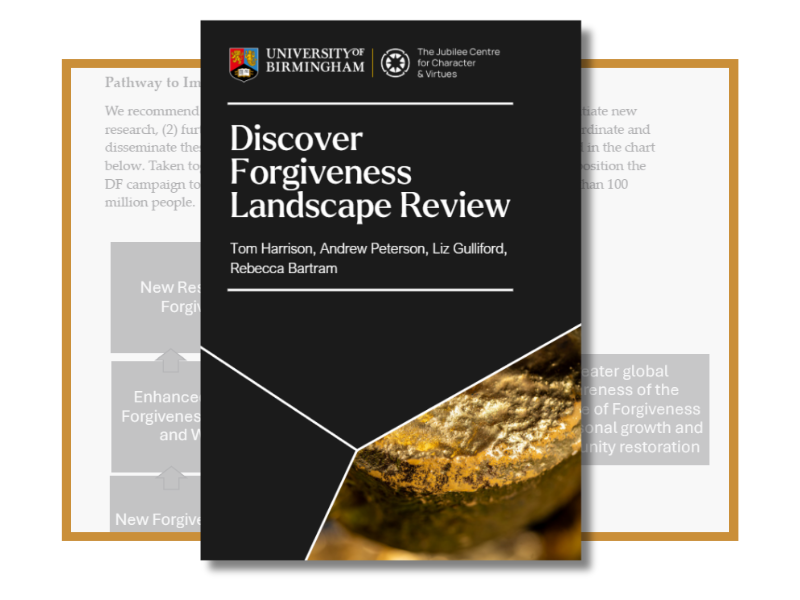
The aim of this landscape review, funded by the TWCF, is to initiate a gear change in enhancing and expanding the Science of Forgiveness globally. Drawing on empirical data and expert opinion, the report provides recommendations for strategically scaling the Science of Forgiveness, paying particular attention, and using as a case, the Discover Forgiveness campaign. The Discover Forgiveness campaign, launched in 2020, focuses on reaching key professionals—mental health practitioners, educators, and faith leaders—who are best placed to support individuals on their forgiveness journeys. Through curated research, the Discover Forgiveness website (https://www.discoverforgiveness.org), and targeted events, TWCF aims to empower these groups with tools and knowledge to share within their communities.
An eight-month landscape review involving 53 participants across 13 countries aimed at providing an overview of the current state of play in disseminating the Science of Forgiveness as well as identifying key players, trends, gaps, challenges, and opportunities for the Discover Forgiveness campaign. The report also contains insights from a strategy workshop with experts in forgiveness research and practice held in Canterbury, UK in July 2025.
The report marks a pivotal step toward broader global awareness and collaboration, encouraging and equipping trusted professionals to lead the way in advocating for the Science of Forgiveness and its application as a transformative tool in their fields.
Key Recommendations
Recommendation 1: Fund New Research in Future-Focused Priority Areas
There is a need to develop a list of priority research projects that address key gaps in the literature, alongside a list of potential funders. Priority areas include interdisciplinary research on forgiveness in the age of AI, forgiveness in law and justice systems, forgiveness in diverse cultural and faith contexts, the relationship between forgiveness and other core concepts and practices (e.g. flourishing, restorative justice, or guilt) and self-forgiveness. Additional areas of focus could include forgiveness in education and youth development, forgiveness and mental health with particular attention to trauma recovery and resilience, as well as forgiveness in prisons and peacebuilding in conflict and post-conflict settings.
Recommendation 2: Develop the Discover Forgiveness Campaign
The Discover Forgiveness campaign should be strengthened to ensure that its website becomes the global hub for accessing and communicating forgiveness research and resources.
Important developments include the translation of resources, with initial priorities being Chinese and Spanish. The campaign should also more clearly foreground the personal, relational, and societal benefits of forgiveness, expand its use of multimedia content such as videos, podcasts, and infographics, and provide tailored toolkits for educators, healthcare professionals, and policymakers. In addition, a stronger digital and social media presence will be essential to extend the campaign’s reach and impact.
Recommendation 3: Establish a New Forgiveness Global Network
A new Champions of the Science of Forgiveness global network should be formalised and coordinated to support both the Discover Forgiveness campaign and new research initiatives. This network could connect with the emerging Global Character Alliance to enhance impact, effectiveness, and efficiency. It would align the Science of Forgiveness more explicitly with influential leaders and global movements beyond those already engaged in forgiveness research and practice. The network would also initiate an annual programme of targeted presentations on the science of forgiveness at major national and international conferences, thereby inspiring new audiences and creating opportunities for collaboration, knowledge exchange, and advocacy across regions and disciplines.